SOUTHEAST ASIA TRAIL RUNNING CUP: Cibodas, West Java, Indonesia · 24–26 July 2026
Once every two years, national federations from across Southeast Asia send their fastest — and their youngest — trail runners to a single mountain to race for regional titles. But the SEATR Cup was never only about who crosses the line first.
More Than a Finish Line
The Southeast Asia Trail Running Cup exists at the intersection of sport and diplomacy. Long before a single athlete arrives at the start line in Cibodas, national federations from across the region have spent months coordinating rosters, travel, and accommodation — an operational partnership that, quietly, is as significant as the race itself.
This year, delegations from eight confirmed nations — Cambodia, Malaysia, Brunei Darussalam, the Philippines, Indonesia, Singapore, Vietnam, and Myanmar — are converging on West Java, with Laos and Thailand’s federations still finalizing their own registrations. For a few days, the alpine botanical gardens of Taman Nasional Gunung Gede Pangrango become common ground: a shared landscape for nations whose runners rarely get to train, travel, or compete together.
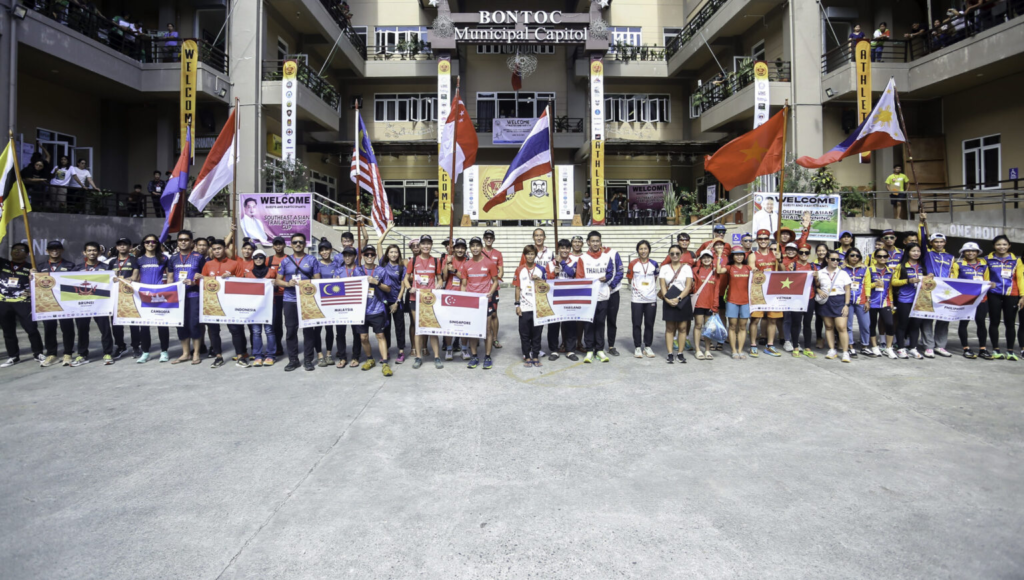
That gathering matters beyond the results sheet. Team leaders and coaches share accommodation blocks arranged room-by-room across federations. Officials from rival nations sit side by side at technical meetings. Athletes who will contest the same climb an hour later spend the evening before comparing notes on altitude training and race nutrition — relationships that persist long after the medals are handed out and often reshape how these athletes and coaches approach the sport back home.That gathering matters beyond the results sheet. Team leaders and coaches share accommodation blocks arranged room-by-room across federations. Officials from rival nations sit side by side at technical meetings. Athletes who will contest the same climb an hour later spend the evening before comparing notes on altitude training and race nutrition — relationships that persist long after the medals are handed out and often reshape how these athletes and coaches approach the sport back home.
Investing in the Next Generation
The Cup’s Junior category — open to athletes racing the 10K Mountain Classic — is deliberately built into the same event as the senior elite fields, not staged as an afterthought. Young runners from Malaysia, Indonesia, Myanmar, and the Philippines take to the same mountain, on the same weekend, as the region’s most decorated ultra-distance athletes. For a sport still establishing its competitive pathways in much of Southeast Asia, that proximity is the point: it gives the next generation a concrete, early benchmark for what regional and international competition looks like, years before they might otherwise encounter it.
This year, for the first time, participating athletes’ ITRA Performance Index scores and IDs are being compiled alongside national rosters — giving federations, for the first time, a standardized, cross-border way to track athlete development against their regional peers rather than in isolation.
The early signs are encouraging: in only its second year, the Junior category has grown to 20 participants, up from just 5 in 2024 — a strong early signal of the sport’s upward trajectory in the region.
A Regional Competition that Paves the Building of Each Community
Behind the results lies a considerable logistical undertaking. Each federation conducts its own selection process, rallies its own community to support its athletes, and works with trail event organizers along the way. While some countries already have advanced systems in place — the Philippines, for instance, is the only national federation in Southeast Asia already recognized by the International Trail Running Association — SEATRC fosters shared collaboration and mutual support system to promote every country’s growth.
The Cup builds on a rotating hosting model — the Philippines staged the event in 2024, and Indonesia’s Jakarta Open Trail Run organizing committee takes on the role in 2026. Each host inherits not just a race to run, but a growing archive of participation data, contact relationships, and institutional knowledge that makes the next edition easier to pull off than the last.
By the Numbers
Figures below reflect confirmed federation registrations as of this brief. Member Federation, Laos will not be participating but is in the process of establishing itself for the competitions to come.
| 8 nations confirmed | 130 registered athletes | 30 team officials | 5 race categories |
| 77 / 53 men / women | 151 total race entries | 9 Member Nations | 3 days of racing |
Storylines to Watch
With rosters finalized, several head-to-head storylines are shaping up across categories, built on 2024 SEATRC results and current ITRA Performance Index rankings.
Vertical — Opening the Event: The Cup kicks off with the Vertical Uphill, where 2024 defending champions Phitchanan Mahachot (THA) and Yusri Nanda (INA) return to defend their titles. They’ll be joined by a handful of U23 athletes and several competitors with World Mountain and Trail Running Championships (WMTRC) experience. The title is far from settled, with the rest of the field very much in contention.
Mountain Classic — Senior Women: France-based Cambodian Laurie Phai leads as the most experienced woman in the field on ITRA points. The Philippines’ Joy Beltran and Kana Antonio follow close behind, both racing back-to-back after Short Trail. Fourth-ranked is Vietnam’s Gin Woo Pei Xun, with the Philippines’ Charlotte Muyco next — fresh off her Mountain Classic World Championship experience. Several other entrants remain firmly in contention beyond this group.
Mountain Classic — Senior Men: One of the tightest fields of the weekend: 20 men within close range of each other, all above 600 ITRA points. The Philippines’ Pugoy leads at 720 points, also racing back-to-back, followed by a tightly bunched group of eight athletes from the Philippines, Indonesia, and Vietnam. Jean Jacques Mok (Cambodia) and Sam Manuel (PHI), both fresh off WMTRC experience, add further depth to the field. With so many athletes closely matched on points, the race remains wide open beyond the names above.
Long Trail — Men: Two 2024 champions collide. John Ray Onifa (PHI), the reigning 2024 Short Trail gold medalist, moves up to Long Trail, where he will face Jay Jantaraboon (THA), the defending 2024 Long Trail gold medalist. On ITRA points, the field is led by Joebert Elmaguin and Arnie Macañeras (both PHI, 800 points), with Vietnam’s Ngô Văn Chính close behind at 715–750, and Indonesia’s Sobari Herdiana and Rahmat Mangkasara rounding out the nearest contenders. The category remains open to other athletes not listed here.
Long Trail — Women: Defending champion Elizabeth Dangadang (PHI) returns to defend her Long Trail title against a new generation of challengers. Vietnam’s Nguyen Thi Tra Giang is her nearest rival on ITRA points, setting up what should be an exciting race. The field has grown considerably since 2024, when just 5 women entered and only 2 finished; this year’s edition features 13 female competitors, several of whom remain firmly in contention for the podium.
Short Trail — Women: None of 2024’s medalists return this year, opening the field wide. Singapore’s Denise Lo holds the highest ITRA points among entrants, followed by Vietnam’s Phung Thi Tra, Cambodia’s Lucie Gerard, and the Philippines’ Kana Antonio and Joy Beltran. Notably, Gerard and Beltran were the top-ranked Southeast Asian finishers at the last World Championships. The rest of the field remains in contention for a podium spot.
Short Trail — Men: Led on paper by two 2024 silver medalists — Romnick Tongkaling (2024 Short Trail silver) and Larry Apolinario (2024 Long Trail silver), both PHI and both sitting at 818 ITRA points. Vietnam’s Sung A Phu trails closely at 804 points, with Malaysia’s Sheron Sariman ranked fourth. As with the other categories, the final standings remain open beyond the athletes named here.
Our Shared Goals
The Cup was founded on a simple premise: that Southeast Asia’s trail running community is stronger united than scattered across a dozen unconnected national scenes. Since its 2024 debut in the Philippines — where PHILTRA hosted roughly 100 elite runners from across the region in Bontoc, Mountain Province — five goals have anchored the event, and continue to shape how it’s run today.
- Camaraderie over rivalry — building the event so that competitors, coaches, and officials from rival nations spend as much time together as apart, sharing accommodation, meals, and start lines, so that friendships outlast the results sheet.
- Cultural exchange — routing courses through host communities’ rice terraces, weaving villages, and sacred landscapes, so visiting delegations experience the host nation’s heritage firsthand, not just its trails.
- Unity of the regional community — treating the Cup as a once-a-year reunion for a sport still finding its footing in much of Southeast Asia, where the relationships built between delegations matter as much as any medal.
- Shared standards — using each edition to push federations toward common definitions of quota athletes, age categories, and results verification, laying groundwork for the sport’s long-term regional credibility.
- A bigger stage — SEATRC leaders have both spoken publicly about growing the Cup toward inclusion in the Southeast Asian Games and, eventually, the Olympic program, alongside World Athletics and the Brisbane 2032 organizing committee. This also helps other member federations path to be able to participate in the World Mountain Trail Running Championships. Currently, only Cambodia, Indonesia, Malaysia, Singapore and the Philippines have showing in the world stage.
- Environmental stewardship runs alongside all five: the 2024 edition was explicitly framed by its hosts as a demonstration of “environmental responsibility,” with courses designed to showcase — rather than disturb — the landscapes they pass through, from the Chico River crossing to the rice terraces of Samoki Village. This year will be no different, with the government of Indonesia in full support, not just for the event but in ensuring the Gede Padarango park is protected.
Quick Facts
| Dates | 24–26 July 2026 |
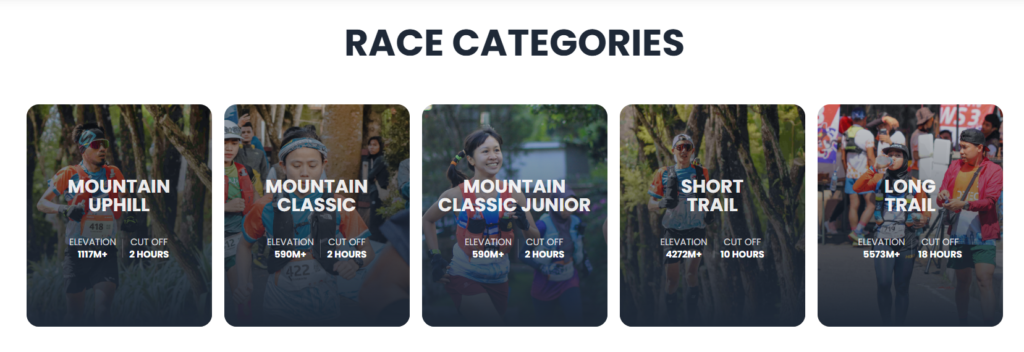
| Categories | Long Trail 75K · Short Trail 42K · Mountain Classic 10K (Junior) · Mountain Classic 10K (Senior) · Vertical |
| Venue | Taman Nasional Gunung Gede Pangrango (TNGGP) — Cibodas Botanical Garden Cianjur, West Java, Indonesia Alpine botanical gardens surrounded by lush mountain vegetation |
| Nations Participating | Cambodia · Malaysia · Brunei Darussalam · Philippines · Indonesia · Singapore · Vietnam · Myanmar (Laos & Thailand pending) |
| Event Website | SEATRC – Jakarta Open Trail Run |
| SEATRC Website | seatrc.com |
| ITRA Race Profile | SEATR Cup — Mountain Classic on ITRA |
| Past Edition | June 2024 — Philippines: philtra.ph/seatrc |
| Social Media | facebook.com/SEATrailRunning · Instagram @seatrc |
| 2026 Video & Photos | JOTR 2026 — Google Drive |
SEATR Cup 2026 is organized under the Southeast Asian Trail Running Confederation (SEATRC), earning ITRA Performance points, and the host federation’s local organizing committee.
